New York City Fiction

Pop Lit Fiction

TODAY we offer a slice of New York City, via a very cool and quick short story, “Unstuck” by Kate Faigen.

The so-called Big Apple remains one of the most fascinating cities on the planet due to a host of characters all jammed together amid shops, skyscrapers, subways, mad traffic, culture, parks, and a smattering of confused sightseers overwhelmed by the experience.

GRANTED, not enough New York, or at least Manhattan, writers have signed the petition to “Save the Writer” from the onslaught of chatbots– the Bronx is better represented than Manhattan!– and our eventual plan is to move the center of American literary culture outside the city of concrete canyons. Nonetheless we present a classic-style tale, a yarn, the kind of quirky narrative told around a campfire– or under a streetlamp to enthralled listeners in urban neighborhoods like those in the Bronx– and we trust you’ll like it.

Today in Central Park I clocked the fourteenth weirdest thing I’d seen all day, which is no small title. A man rolled his eyes so hard that they got stuck. Right up there toward the sky like a rocket frozen in launch.

XXX

BY THE WAY, if you care or dare to sign the aforementioned petition, you can do it here. We thank you and thank everyone else who’ve appended a name or pseudonym or gone anonymous on the list to help protect writers and inform readers about plutocrat-enriching electricity-draining botbooks.
Human Fiction

Pop Lit Fiction

WITH IMMENSE CHANGE happening or about to happen at all levels of the literary and publishing worlds with the advent of A.I.-generated texts, at New Pop Lit we’re thinking about what’s important in our modest project. What do we wish to say or accomplish in coming months?

MOST IMPORTANT for us is the ideal of human creativity. Publishing the very best fiction and poetry– which we’ve been doing– while exploring new ideas of deep learning of human beings instead of deep learning of machines. Ideas counter to those of plutocrats pumping billions of dollars into ever-more advanced, ever-more insane technologies.

OUR LATEST example of excellent fiction not generated by bots is our new feature, “The View from a Window of the House on the Embankment” by Mark Marchenko. A story about the old Soviet Union– its author calls it “an alternative history fiction piece”– but maybe also a story about today. We hope you like it.

When the knock came at the door, Georgy was standing with his hands at the windowsill, gazing out of the window. Grey sky hung over Moscow. Before his eyes was ground covered with autumn splashes of orange and red, the square that was named after Repin (it was in 1958 when the monument to Ilya Repin, a Russian realist painter, was built on Bolotnaya Square; in 1962 the square was renamed Repin Square) just a couple of months ago, withered grass awaiting the first snow, a band of water, and the walls of the Kremlin. A river, slow, almost black, under his feet.

XXXX

(ALSO, the “Save the Writer!” petition calling for labeling of A.I.-generated books– a modest ask– is ongoing. Please read and consider signing. 441 readers and writers have done so to date. Thanks!)

New Fiction 2023

Pop Lit Fiction

ALREADY one month into the New Year and we finally put our first fiction feature up at our site. (A sign of our selectivity? The benefits of waiting?)

The story is “Glow Worm Farm” by Kathy Lanzarotti. One of the rare stories where both NPL editors not only agreed on the selection, but 100% agreed, in that we’d both give it scores of 10 out of 10. The question: Why?

Perhaps because it’s a template for an ideal short story circa 2023, when the task is to make the art form relevant and compelling. The story has it all– acknowledgment of the madness of today’s world, including the future of that world (robots)– with swipes at media and consumerism– with no shying away from politics, in highlighting violent aspects of the current extremist political landscape. Ostensibly set three years into the future, the tale makes the reader realize that future is here. The story contains also, amid the madness, an embrace of the natural, the living. That which gives life meaning. We’ve run a series of topical stories of late– as well as stories with great sensibility and emotion. “Glow Worm Farm” scores on both counts.

Topicality and emotion: a powerful combination. Must reading for anyone interested in where short fiction is now, and where it’s going. Where it should be going.

When the National Guard arrived, most of the neighbors were outside. Sarah watched them trade rumors from the nutshell of her porch swing. Mayberry on her lap. A cup of cinnamon coffee in her green mug that read, I’m a Ray Of Fucking Sunshine. Rumors and speculation was all anyone had at that point. The WiFi and cell service, TV and radio, stopped with the blast. Sarah was no scientist but she’d watched enough movies to know this wasn’t a good sign. And then there was the sky, cast a hazy pink orange that was both light and dark at the same time.

More Poetry

Poetry

WITH THE WORLD per usual in turmoil, poets and poetry are more necessary than ever. With that as context we present “Heaven Bound” by Alisha J. Prince— the kind of poem we love in its expression of rhyme and rhythm, its ambition, and the way it captures the reality of life in London, England. Alisha is one of the overlooked literary talents we’re always happy to stumble into– because the future of this project, and of literature itself, resides in them.

Crimson chaos fills the gaps
Inside the council pavement slabs
Torn and ravaged pizza boxes
Rats and bats and cats and foxes

(NOTE: We also have new fun stuff coming in a day or two to our revamped Special Projects blog. Not to miss!)

Are Fast Food Poems Pop?

Poetry

DILEMMAS OF CORPORATE CULTURE

ARE fast food poems pop? Or art? Andy Warhol would argue they’re the essence of pop art.

Corporate culture is ubiquitous and it’s also America’s addition to the culture of the world. Coca-Cola wasn’t simply a brand. It advertised American populist ideology to the planet. Some might call it cultural imperialism and others would say it’s only a soft drink.

Jimmy John’s is just a sandwich.

Where do we draw the line? Is the intersection of art and commerce allowable? The bigger question: Is it avoidable?

Our take: If a competing literary site can dedicate their entire oeuvre and reason-for-being to a fast food taco chain, then we can present three terrific prose poems about Jimmy John’s.

Chelsea Sieg is one of the best young writers we’ve come across in a while. A writer with the rare ability to combine humor and poignancy with a perfect flow of words so that afterward you shake your head at the accomplishment. Three prose poems: “The Jimmy John’s Poem Collection.” Read them.

it was a simple, quiet, two am kind of happiness, the kind you don’t have to think that hard about. it was a small, soft hope. and I would have eaten every sandwich on the goddamn menu, mustard and all, to keep it alive.

<<<<>>>>

(Art: “Still LIfe with a Beer Mug” by Fernand Leger.)

Adventure and Style in Fiction

Pop Lit Fiction

STANDARD in classic fiction of the past, especially from short story writers, was a sense of style or adventure– or both. Jack London and O. Henry emphasized adventure— albeit very different types of adventure: wilderness and oceans on the one hand, stray unpredictable adventures which could assault a person in cities like New York on the other. Writers Edith Wharton, Henry James, and F. Scott Fitzgerald placed more emphasis on the kinds of styles exhibited by their characters, and from the sophisticated settings in which they moved. This was back when the short story was the popular American art form.

Today we present a story which captures that much-needed sense of mystery, adventure, and style, “The Names Divine” by C. A. Shoultz. Our first feature of 2021, with more to follow.

In due course they arrived atop the stairs. Simon walked beyond the masked man and beheld a table covered in black velvet. A sign above it, written in gold script, said: “Choose your mask. Choose your name.” Sure enough, upon the table were a small number of masks just like his escort was wearing. They were widely and irregularly spaced apart, a sign that many others had come here before him and done what he was about to do.

<<<<>>>>

(Art: Above: “At the Masked Ball” by Jean-Louis Forain. Below: A section of a poster for a movie by Gaumont Films.)

Carnival Fiction

Pop Lit Fiction

A MARDI GRAS STORY

Great 19th century novelists such as Victor Hugo, Charlotte Bronte, and Alexandre Dumas would often put a big scene of a carnival parade into their books. The feeling of uninhibited revelry, chaos, even madness was a way of heightening emotion and consolidating plot threads– as if the true hidden nature of their characters came out– came alive– amid the colors, music, drinking and shouting. 

WE HAVE today in time for Mardi Gras 2020 a short story centered around carnival time in New Orleans, and it’s a good one: “Cracks” by Wilson Koewing. The story of course is about more than a parade. It’s about a relationship– more, it’s about life, about love, about being human and filled with the kind of chaotic mad emotions we flawed creatures are prone to. Put on your Mardi Gras mask and plunge in.

As we close in on St. Charles, the din of the crowd materializes. Carnival food smells ride on the breeze. You sense the impending madness. It rushes slowly, not towards you. You enter. It surrounds you. And you’re inside. There is a wall, and when it envelops you, there is no escape.

>>>>>>>

(ART: “The Peacock” by Natalia Goncharova.)

Pushcart Art

Announcement

OUR 2019 PUSHCART PRIZE NOMINATIONS

AS WE ARE at present strictly a bootstrap, “pushcart” enterprise (with plans to dramatically change that standing), we appreciate the intent behind the annual Pushcart Press Pushcart Prize collections. Being able to nominate a few of the quality writers who publish work with us is one of the great blessings we receive from running this literary project.

WE BELIEVE our site is particularly in synch with the Pushcart spirit– not solely because of our small size, but also because we’re endeavoring to create a new model for both short fiction and poetry. A model not only different from standard “Big Five” publishing, but from the kind of work featured in more established literary magazines and included in such anthologies.

ANYWAY, here are our 2019 nominations. We invite you to click on the links to the work, and read or reread the nominated pieces.

Thanks!
*******

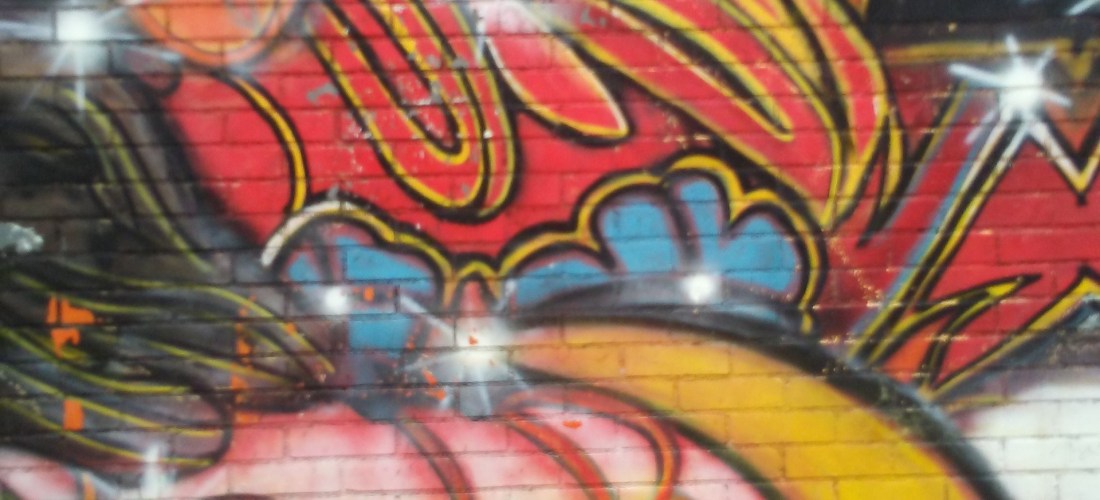
(Art: Graffiti in Ann Arbor, Michigan.)

Reading for Colder Weather

Pop Lit Fiction

Colder weather is upon us! Sooner than anyone expected. Which means it’s a good time for reading. At New Pop Lit we have several options for the discriminating reader.

FIRST is our new feature story, “Pretty Women Never Sit Next to Me on Airplanes”  by Jason Feingold, a much-published short story writer making his first appearance with us. As its title indicates, it’s a quick tale about traveling. As so many of you will be traveling somewhere in the coming weeks, with the holidays nearly upon us, we believe you’ll find the story timely.

Age fourteen was my last good year. I’d peaked, and I never realized it until about fifteen minutes ago, because fifteen minutes ago is when I realized I’ll never have a renaissance.
****

WE ALSO offer a review of a controversial new book by Dana Schwartz, The White Man’s Guide to White Male Writers of the Western Canon. Does the book live up to the controversy?
****

FINALLY, we have at our NPL News blog (which presents the latest literary news, uncensored) an editorial about this past week’s layoffs at Bustle magazine. The editorial is bold. Don’t be thrown by it. As an upstart literary project with large ambitions, confidence in our project is the first requirement.

Read away.
*******

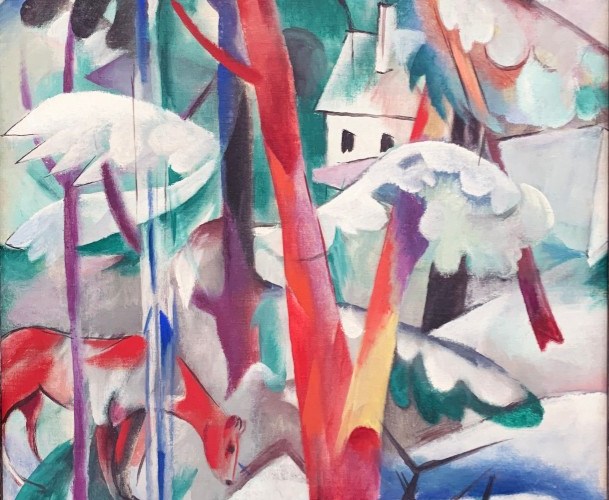
(Art by Heinrich Campendonk.)

Short Summer Fiction

Pop Lit Fiction

IN THE MIDDLE of summer everyone seems to be traveling or escaping, from the heat of jobs or the stagnation of their lives. In  the middle of summer, we like to sometimes present short summer fiction perfect for reading about exotic locales where you might like to travel to, or at least imagine being there.

Today we have a well-written short story by talented writer Zachary H. Loewenstein, “Jerusalem,” which in concise words captures the bustle and heat of the well-traveled city– as if he were creating a painting instead of a story. We think you’ll enjoy it.

“It was just right about there.” The entirely bald and unlicensed tour guide pointed with his swollen index finger. His brain was cooking in the heat and he shouted. He clapped his hands and insisted, “Ok! Everybody! It’s time to move to the market! Everybody!”

*******

(Art: “House in the Garden 1908” by Pablo Picasso.)