
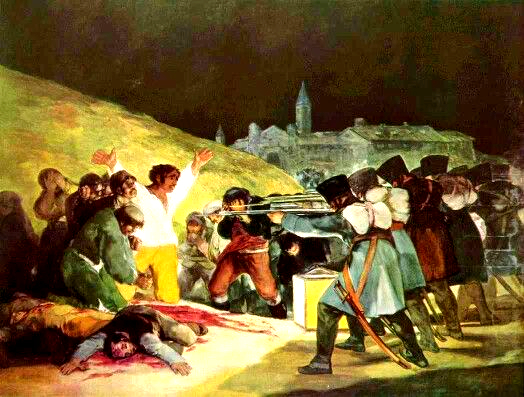
“The Third of May, 1808” by Francisco Goya.
by John Van Wagner
The man is angelic, translucent in the pale afternoon sun, face uplifted, arms outstretched, voice beseeching. But he is mortal. He asks for death, taunts it. Kill me, he exclaims, shoot. I dare you.
And yet death is not his longing. Redemption is.
George stands transfixed, straining to hear the man’s words. The vicarious stench of smoke and gunpowder seeps into nostrils. He stifles an impulse to pump his fist in the air, to cheer the man, for never has he witnessed courage so pure.
But he’s in public. The gallery is filled with whispering patrons, and he should not make a scene. The security guards, bored to distraction by the chronic lack of incident at the august Gotham museum, might be eyeing him with interest already.
So George remains quiet while his synapses fire with abandon. He’s lived his life like this, all sixty-three years of it, a silent observer, abiding by rules, quietly amazed. He’s in awe of the talent of the man whose work he absorbs, and who, he concludes, is more alchemist than artist, blending brushwork and line with such precision and fluidity that two dimensions evolve into three, and then four. Color, light and shadow become sound, taste, and touch. Every canvas here has transformative power. But for George the painting of the defiant soldier on the depleted civil war battlefield transcends. He is all aspiration, his fingers reach up and strain to brush the hem of God.
A young couple appears in George’s peripheral vision, and to let them see he backs away from the picture with reluctance. They murmur to each other, not about technique, or historical context. They’re talking about where they are going next, to the Guggenheim, to Per Se, to Rome.
People circulate in couples and small groups. There are a few solitary souls like George. One of them weaves in and out among the spectators, uttering inanities, apparently startled by the sheer volume of paintings around every corner. “This guy’s exhausting!” he exclaims to no one in particular. George disagrees.
Each image here highlights the filament that separates life from the void. On one wall a man sprawls on a flimsy sailboat with a broken mast in the open ocean, sharks inches away, mouths agape, black eyes manic with hunger. On another, two seamen measure their fate with a primitive compass, while on the horizon fog advances with its promise of blindness and oblivion.
Further on, a wall of water explodes over a cliff, indifferent to a tiny human figure bundled against a Maine nor’easter, fate unknown. And there are many more. Each frames the terrifying prospect of impending knowledge, of heaven’s implacable destiny.
The young couple has moved away, and George stands alone. He becomes aware of time, and glances at his phone. Cynthia hasn’t texted. He has no reason to think she will. But she always has, most every day, several times, even if less and less. They still have business to discuss, details, particulars about possessions and paperwork. After thirty two years of marriage, there is a psychic attic in place, and George imagines—hopes—that it will take long months, years maybe, to empty. There are still ties. Or at least there are imperatives. There are, of course, the children, even if grown. Perhaps, George considers, there’s no cell service within the walls of the gallery.
George exits to the main hall, sits on a bench and thinks. He has taken pictures of the paintings. He suppresses an impulse to send some to Cynthia, on a pretext of some kind, to share his wonderment. He knows she would find it presumptuous, and perhaps intrusive. He bores her now. Maybe he always has. She has expressed, in the kindest and firmest possible terms, that she sees no point in moving forward, sharing life. She has tired of measuring it out in coffee spoons, with nothing at stake. She wants more. It’s not his fault. It’s just the way of things.
She has spoken of love. Not of its nature, or its importance, but of its absence. And of her yearnings. This was startling to him at first. He still struggles to comprehend her, to see what she needs him to see, understand what she wants. He has been a happy man, a practical one, successful in the way all accountants are, or at least most, content with a life where concrete answers are there for those willing to wade through the minutiae, to make peace with tedium. He knows the common view that love comes in many dimensions, that it can’t be defined or predicted. But for him, complex though he understands it to be, it has only one object, and one conclusion.
Despite the decades of frustration, Cynthia has been dutiful, has tried multiple ways to help him comprehend what he knows she knows in her heart. He has at times felt more like a failed student than an obtuse husband, for Cynthia is a superb teacher, as all of her students at Hunter attest on Rate My Professor. But her years in classrooms have taught her more about limitation than potential, she’s often said. Gifts and talents are distributed—and withheld—at birth, though only toward the end of her career had she fully accepted this. Since their youngest left for Stanford, her emotional tutorials for George have become formal, and resigned. Since her departure George spends unstructured days—like this one—on meditation, on discovery. He’s taken up the dulcimer, signed up for a history class in the fall at the New School, contemplated learning to fly, maybe to rock climb. But he’s uncertain about what will impress her most. So he thinks some more.
He’s argued to her that he’s not an unimaginative sort for an accountant, that he has the capacity for passion, even if he’s quiet about it. Sometimes he’s thought she accepts this. But always he fears something in the mirror of her gaze, the reflection of a man who won’t risk. A milquetoast. Someone no woman could love.
And there is more. With infinite time to think, he tries without success to banish the gnawing realization that she has found someone else.
Outside on the grand avenue George rests on the granite steps of the museum, absorbed in the simple musical notes of a street flutist who plies his trade in between food trucks hawking sausages and sodas. Out here, there can be no question, there is cell service. And still there is no text.
The minutes pass. The late afternoon light is pale pink, crowds of tourists mills about, lethargic and content. George plays chess on his phone, a good way to occupy fingers that long to send a message of nostalgia, of endearment. He loses his Queen, leaves the game, and returns to Messaging. Risk it, he thinks. And does nothing.
Walking into the nearby park, George considers buying a snow cone, or a knish, and settling down on the green hillock above the museum to watch the evening unfold. Rollerbladers glide by, effortless motion. One of them almost clips him, he feels a whisper of nylon from the man’s shirt on his elbow.
He wanders on, imagining a vibration of the phone in his pocket that is never real. He walks toward the middle of the park, having a vague idea of the location of the central court, with its baroque fountain. Finding it, he moves toward the steps leading to the bridge nearby, where he can have a better view.
But before he reaches it he stops. There is a snake in his path.
The snake is long, maybe eight feet, and thick. George believes it’s a boa constrictor. Or an anaconda. He’s vague about the difference.
While startled, George is not frightened. People take little notice, it’s just another city distraction. The reptile proceeds with languid intention, slithering across the courtyard tiles, as if moving simply for motion’s sake. It is yellow, with a delicate black and green design adorning its scales, so decorative and deliberate that George wonders at first if it were painted on. It reminds him of the lacy filigree of the Moorish frescoes from southern Spain, and Morocco, and of the day he spent with Cynthia in Marrakesh before the children were born. He wonders if she remembers that day, that time.
“Twenty dollars,” a voice intones nearby. George looks up to regard a swarthy young man, with black eyes that mirror the snake’s. “You can hold it.”
The park seems to spin. George wonders if anyone else is witnessing this scene. People breeze by, they cool themselves by the fountain, they eat pretzels with mustard. The snake handler doesn’t smile. But he sees. Somehow, George considers, this man knows a good mark.
“How about fifteen?” George asks, reaching behind him for his wallet.
“Twenty,” says the man. George considers shaking his head and walking on. But to where, he doesn’t know, or for what. The creature begins to slide off in a different direction, and George feels the moment slipping away.
This is something he can share with Cynthia. Something to tell her. He pictures her eyes widening when the text comes through with the image of himself and the serpent, her head shaking in that imperceptible, tremulous way, her expression softening, a tiny involuntary smile enlivening her face. He even thinks of a caption: St. George and the Dragon! Sort of! And maybe a heart emoji.
Risk it, fool. Roll the dice.
“Can you take a picture?” he asks the man, and pulls out a twenty.
“Sure, boss. Twenty-five.” George hands over his money and his phone. The man walks over to the snake, bends down, extends his hand to it. It slides up and around his arm, around his body.
Is there any trick to this, George wants to ask, do you have a license? But it’s too late.
The man has edged close as if to embrace. George thinks he feels an arm drape over his shoulder, a gesture of encouragement. He looks up, hoping to find a smile.
What he sees are snake eyes, already turning the corner of his shoulder, navigating his neck. George expects something wet, and slimy. But it’s not. It’s warm and smooth, almost silky. Sensual.
He surrenders. All anxiety evaporates, and he utters an impromptu gasp of surprise and delight. The snake embraces his torso, winds around his arms. George revels in the sensation of fusion, feeling the way a newborn might when swaddled tight in soft cotton, clean, dry, safe, and waiting for Mother.
The creature is female. George knows this even before he hears the handler begin to say her name, as if she can hear. She is skilled in the art of seduction, gentle, disarming temptation. Even as the endless body wraps around him with more insistence, George feels rapture. Unaccustomed, long dormant sprouts of arousal burst through. He perceives a delicate scent in the air. It evokes a memory: Cynthia, moving among guests at the company picnic, glancing at him with a conspiratorial signal of something promising to come, a liberation.
The moments pass, or perhaps they are hours, for they assume an eternal quality. George glances at the handler, and sees that his expression has changed, his eyes are different now, not hard. He’s seeing something unexpected, maybe unprecedented. and he is uncertain, even anxious. George wishes he would disappear, that all the people in the park would disappear. When he realizes that he cannot breathe, there is not panic. On the contrary, there is serenity. Acceptance. Love.
The handler has begun applying pressure to the snake at various points on its length, attempting to dislodge it. Foolish man, George muses. The young have such hubris, to think they have power over what they do not understand. This moment can’t be forced.
But it must be captured, George realizes with a start as he attempts respiration, speech, and cannot.
Take the picture, he tries to stammer to the alarmed handler, who has abandoned whatever techniques taught to him in snake training and is trying to pry the snake off with brute strength. “Honey!” the man exclaims in a voice that suddenly sounds like a boy’s. “Honey!”
George can’t make a sound. Now he does begin to panic, but not for lack of air. The handler is desperate, and the phone has disappeared. The snake tightens its grip. Stop it, George implores the handler with his eyes, take the picture, as I’ve paid you to do!
More people have begun to gather, and take note. George hears chatter about the boathouse, and whether it’s closing for the season, about opera in the park that evening. There is only passing interest in this display of street theater, but they’re starting to look closer, and to consider the implications of what they see. George locks eyes with one young girl, not more than fifteen. Her return gaze is different. She understands. And with an expression less of concern than fascination, she lifts her phone and taps. In the fading light the device flashes.
In the moment before people freeze to death, George knows, they feel hot, they shed their clothes in an undignified, ecstatic sprint towards oblivion. Then they crave sleep. As he’s being crushed, George feels a similar paradox. His body expands, it is everywhere, all over the park, the city, in the sky. He senses the snake whisper to him, urging him on, daring him with the promise of wonders and answers known only to the chosen. Have any of her other prey—the rats, rabbits and baby calves—felt the power of this grace? No, he concludes, I am different, there is something in me only she can see. And when the image of this encounter floats through the ether to Cynthia, she will see as well.
And then, strangely, George is hungry. What do you most desire, the snake inquires. He cannot say. But Honey knows.
Her embrace alters, it is more complicated, it implies something else. There is rage in it, the fury of the neutered captive. In George’s widening vision he sees her story. There has been no jungle, no cunning thrill of the hunt, no primeval magic, no stealth. There has been, for her, only the sterile cement of cages, the degradation of exposure, her life a denatured stew of prying eyes and the rotting flesh of rodents dropped with indifference into her mouth by those who would enslave her. In him, in his weakness, she seeks retribution. Or something else. Release me, he thinks he hears her say, and I will let you live. I do not have the power, George thinks.
The young girl’s flashes have ignited a firestorm of phones. There are exclamations—of alarm, or excitement, or both—and cameras fire in a torrent of light that strikes like bullets. George feels Honey’s embrace weaken.
Don’t stop, not now, he tries to stammer, as breath returns to his lungs in an instinctive rush, and Honey surrenders to the blinding assault. The people are barking now, more have joined the throng. there is collective concern, and the handler is beating the snake in a frenzy. George has only a glancing awareness, as his hunger turns to overwhelming yearning, for the climax, the end. But Honey has lost her resolve.
Other lights emerge, the red and blue flashing ones of police, and George knows Honey is blind. She’s about to extend him the mandatory mercy of the defeated. He clings to her, willing her on, desperate for the moment to continue, for another resolution altogether. But Honey collapses at his feet, flaccid, and docile. The handler steps on her neck. His eyes are hard again, fierce, the veins stand out on his forehead, his nostrils flare.
There are faces around George now, talking to him. George is dizzy, and besides, he doesn’t know what to say. He nods to everyone, lets himself be guided over to sit on a nearby bench. People hover over him.
My phone, he tries to exclaim. But it is still difficult to speak. He scans the courtyard for the young girl, for she has the precious photo, she can send it to him, to Cynthia. But she is gone.
As the minutes pass the others disperse as well, to their hotels, cocktail parties, jazz clubs, where they will tell the story of a man in the park who, they think, almost died. Some will share their images of the day, with each other, on Tik Tok. But they are disappearing, and George doesn’t know whom to ask, or how, to please send pictures.
Animal Control is here now, and they have bundled Honey into a container. She is passive, limp. A man and a woman from EMS examine him, tell him his vitals are all fine, but that he should relax, go home and rest, that this was a trauma, but that he was very lucky. He watches their lips move, but he is not listening.
He spies his phone, resting on the handler’s knapsack. It is on, and lit. His trembling fingers search photos, flipping through scores of pictures of paintings, so lifeless and flat, now, sterile stabs at vicarious experience. He is desperate to find the one image of stirring reality, perhaps a video. But there is nothing there. He spies the handler arguing with Animal Control. Leave her alone, let her go, he yearns to exclaim.
He flips through his photos again, and again. He sees a notification. There is a voice mail. From Cynthia.
Before he can play it back, the transcript appears. It is halting and sketchy, with gaps, hesitant. “George, it reads, ….me back tonight. We…talk. Something….to tell you.”
XXXX
John Van Wagner lives and writes in New Jersey. His work was recently published in October Hill Magazine and Potato Soup Journal.
 New Pop Lit
A terrific thrilling story. Original, emotional, could not stop reading it. Thank you.
A stunning clash between civilization and instinct. Van Wagner is definitely a writer to follow.
A beautifully written narrative, so colorful and vivid.