
by Joe Del Castillo
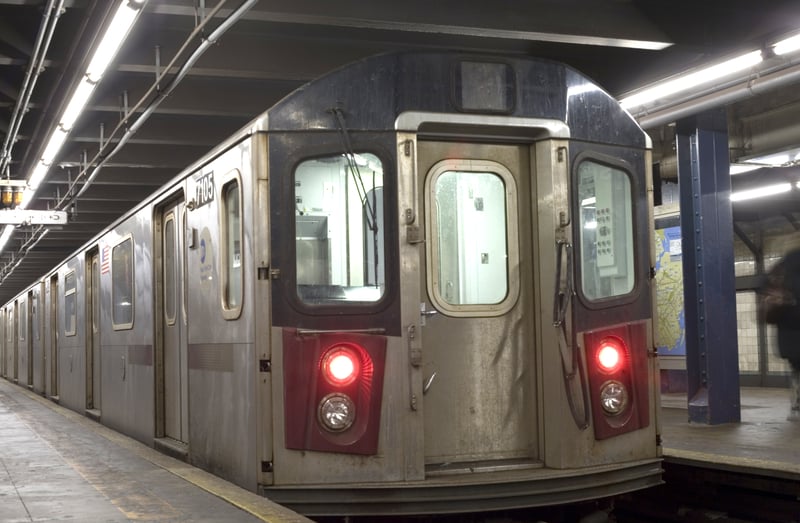
(New York City file photo)
In January, at least twice a week, I visited my gravely ill uncle in his Manhattan apartment. Taking an extended lunch hour, I rode the subway from 14th Street up to East 68th. Although I wanted to be left alone with my thoughts, often a group of five boys, all in their mid-teens, hopped onto my train car to perform a cappella rap songs. Even without any musical accompaniment, I was impressed by their harmony and performance unity. But I didn’t care what they sang about. Actually, I hated it. The words were an endless litany of complaints and frustrations. For me, it was a gauntlet to bear. When we reached a station, having delivered two or three songs, they came around with their overturned baseball caps for donations. The quicker I put in a bill, the sooner I’d be rid of them.
At my uncle’s residence, I’d enter the lobby of the building and the cheerful doorman, even though he knew me, was required to call and announce my arrival prior to admitting me. I then took the elevator up to the ninth-floor apartment. My mid-day visits allowed my aunt extra time to be out of the building for a much-needed change of venue. A hospital bed, in addition to other medical support, took up a third of the living room. My uncle lay in a coma, kept alive by an intravenous unit. A hospice attendant sat by him, his eyes glancing back and forth between his patient and the book he read. I took a seat on the other side of the bed.
No one really knew if my uncle heard anything that I or anyone else might have said. In any case, one tries. For the most part, I brought up memories.
“Uncle Louis,” I said to him, “I recall when you would visit us and how you would take me to the ice cream parlor. Do you remember? I was about ten, and you usually got me anything I wanted. Mom and dad would just get me the occasional ice cream cone, but I could count on you for a sundae or ice cream soda. You let me think it was our secret.”
In those days, my uncle dropped by about twice a month, visits I greatly anticipated. Besides the ice cream treats, he brought presents, usually a toy or a book. However, over time, I grew too old for gifts, and he had to travel more for his job. In high school, I got a part-time job at the ice cream place. I could get whatever I desired. Still, when we could, we’d usually meet there for lunch or dinner, and there was always plenty to talk about; family, politics, but we always ended up debating the music scene.
“Do you remember?” I continued, “I was into the Beatles and all the British Invasion groups that were out then, but you never cared for them. It was difficult for me to understand that you could not see what I saw in those performers. You talked about Sinatra, Ella Fitzgerald, and the like. You insisted that I listen to their music and gain an appreciation for their artistry. I felt I knew them well enough since they were who mom and dad listened to. I now had my own stars and their songs dominated my head. Of course, I was sixteen, so I thought my opinions mattered more. I wanted you to understand what ‘my’ singers were talking about. If your favorites sang about love, mine sang about love, but also civil rights and injustice. Wasn’t that more important? You responded by giving me the Sinatra album, ‘In the Wee Small Hours’. You explained or tried to explain how it expressed emotions that were universal and timeless. Anyone on the planet could relate to them at any time in history. Songs like those would outlast most of what I liked.”
The hospice nurse, Jerry, a man of about thirty, tipped his head in approval. “You do the right thing by bringing up good times and happy memories. I believe he hears you.”
“How can you tell?”
“I just believe it.”
I was unsure if Jerry was being truthful. Maybe he just wanted me to feel better. He was, after all, in the profession of comforting people.
“Are you familiar with the singers and groups I mentioned?”
“Of course I am. Who doesn’t know the Beatles or Sinatra?”
I addressed my uncle. “You did appreciate songs like ‘Yesterday’ and ‘Downtown’. So I felt there was hope for you. I could see why; they had great melodies. And how about ‘My Girl’ by the Temptations? I know you loved that one. The ice cream place usually had a radio playing, and if it came on, we both sang along. I think it was your favorite of my songs. You know the words,” I said, starting to sing the chorus: “I guess you say, what can make me feel this way?”
Jerry chimed in with the words, “My girl,” and I followed through with another “My girl.”
My uncle’s right hand grabbed my wrist. “Uncle Louis, it’s me, Johnny.” His hand then dropped; there was no other reaction.
“You know that one?” I asked Jerry.
“I think everyone knows that song.”
Uncle was unfamiliar with the Motown sound and the music it produced, but “My Girl”, with its pure, joyful celebration of love, was irresistible and infectious. As the song said, it turned your cloudy day into sunshine. To me, the instrumental break, with its chorus of “Hey, hey, heys,” never failed to lift one’s heart. You felt that you could look down from the heavens and see that all was right in the world.
After running out of things to talk about, I would just sit silently or chat with Jerry.
“So you know the Temptations?” I said.
“Yeah, I know a lot of tunes by them. I guess I’m familiar with sixties stuff thanks to my parents. I’m big into the rap scene. That’s my sound.”
“Jerry, I have to admit something. I hope you are not offended, but I have a hard time with rap music. I can admire the performers, but I don’t really like the songs. To me, it’s all anger and animosity. I hear cursing, insults, and threats of violence.”
“Where do you come across them?”
“Well,” I said, “it’s five kids on the train that I take.”
“You are probably hearing ‘gangsta’ rap, which is really an offshoot. Much of rap comes from people who are poor, who live in destitute areas, and who see no chance at improvement. Rap or hip hop lets them express their hopelessness in a creative way.”
“I think God arranges for them to appear whenever I take the subway just to make me miserable.”
Jerry laughed. “I believe the Lord has a funky sense of humor.”
“Expressing hopelessness creatively,” I said, “sounds like a contradiction.”
“Think about it,’ Jerry said. “By becoming an outlet, it creates hope. It’s like new folk music. Isn’t much of folk music often protest music?”
“True, but doesn’t that ‘gangsta’ influence people in a negative manner, especially young kids?”
“I don’t know for sure.” Jerry scratched his head. “Isn’t it like admiring the Godfather movies? Most of us know that real-life mobsters are scum. However, when we see those films, those criminals have some sort of appeal or coolness to them.”
“I see your point.”
“You mention ‘My Girl’ by the Temps,” Jerry continued. “Most of their early stuff was love songs, but they changed. They reacted to current events. Think of some of their other tunes, like ‘Papa Was A Rolling Stone’. That’s about children being abandoned by their fathers. ‘Ball of Confusion’ is about the world being a total mess. Take that to another artist like Billy Joel’s ‘We Didn’t Start the Fire’. In my opinion, that’s in the style of a rap song. It’s a recitation listing the endless problems the world endures over time.”
“And,” I acknowledged, “there’s anger and frustration in those lyrics.”
“Exactly.”
“My uncle, great as he is, had little tolerance for my generation of protest singers. Rap wouldn’t stand a chance with him.”
There was silence. We both looked at my uncle, breathing through the tubes in his nose, eyes closed, no sign of life.
“You always insisted,” I said to my uncle, “that the songs that will last through time are the love songs, those of both sorrow and joy.”
“Maybe he’s right,” Jerry said.
Two days later, I rode uptown to visit him again. As always, I waited for the doorman to call upstairs. Usually outgoing, he didn’t say anything to me. When I got up to the apartment, Jerry met me at the door and informed me that my uncle had died hours earlier. The bed was empty, the machines turned off. My aunt was at the funeral home finalizing the arrangements. There was nothing for me to do. Shaking hands, Jerry and I wished each other well.
I took the elevator back down and looked at the doorman, who said, “I’m sorry.”
I stepped out into the cold. I walked around the block a few times, thinking about ice cream sodas and toys. Finally, I went to the subway.
At the second station stop, just moments into the ride, the door opened and, sure enough, the a cappella singers raced into the subway car. As always, one announced that they would perform and that tips would be most welcome and most appreciated.
I buried my face in my hands. I didn’t need this now.
They linked their arms together. The bass singer intoned a low beat, “Boom boom- bump—boom boom-bump—boom boom-bump.” Another snapped his fingers in counterpoint. A third one smacked his lips and hummed, replicating high guitar notes. The next boy crossed his arms over his chest. He gazed up and his eyes beamed as if he could see through the train roof and beyond the tunnel walls. He sang slowly, stretching out the notes, “I’ve got sunshine… on a cloudy day.”
I raised my head. It was “My Girl”. Never had I heard them sing anything close to a ballad, let alone this glorious song. The group focused on me as if they somehow knew of my loss.
“When it’s cold outside,’ intoned another singer, “I’ve got the month of May.”
They placed their arms behind their backs and moved their feet in synchronized dance steps. In unison, all five clapped their hands and raised them up. They reached the instrumental break, and all joined in the soaring “Hey, hey, heys”. I shut my eyes. My mind heard musicians fade in and the crescendo of the brass and strings fill the subway car.
Opening my eyes, I saw my uncle, sitting across from me, miles away and out of reach. He tilted his head toward the vocalists and smiled approvingly. Then he and I, for one last time, joined the subway artists, backing them up in the singing.

Joe Del Castillo lives on Long Island, New York and is a member of the Long Island Writers Guild.
 New Pop Lit
I love this story it really speaks to music across generations and different points of view! It gave me chills at the end!
Thank you so much.
What a sweet, heartwarming story. I didn’t want it to end. It made me cry and I’m not a cryer. Great work!
Thank you!!
It was beautiful and heartwarming and crosses many different generations.
Love will win in the end
Thank you all for your kind words. I truly appreciate it.
Love this sweet, short story. It touched my heart, especially reminding me of conversations with my Dad who adored opera and who would have been 100 last Sunday. Loved how the universe conspired to have one last song with his uncle.
Wonderful touching story. Truly enjoyed every moment.